Aa
  • Read, Watch, Listen
  • TJI Series
  • Community Action
  • Events
  • Zedi
Follow us and continue the conversation
  • LinkedIn
  • Instagram
  • FaceBook
  • X
  • YouTube
Test yourself with the TJI Quiz!

Adjust size of text

Aa

Follow us and continue the conversation

  • LinkedIn
  • Instagram
  • FaceBook
  • X
  • YouTube

Your saved articles

You haven't saved any articles

What are you looking for?

Original reporting, insightful analysis and diverse views, delivered straight to your inbox

  • LinkedIn
  • Instagram
  • FaceBook
  • X
  • YouTube
Your support fuels our mission to inform, entertain and inspire.

The Jewish Independent is bound by the Standards of Practice of the Australian Press Council. If you believe the Standards may have been breached, you may approach The Jewish Independent or make a complaint to the Australian Press Council in writing at www.presscouncil.org.au. The Council may also be contacted on 1800 025 712.

  • Our Story
  • Contact us
  • Our Team
  • Support us
  • Guidelines
  • Pitch your idea
  • Republishing us
  • Community Action
  • Our Awards
  • LinkedIn
  • Instagram
  • FaceBook
  • X
  • YouTube
Aboriginal FlagTorres Strait Islanders Flag

The Jewish Independent acknowledges Aboriginal and Torres Strait Islander peoples as the Traditional Owners and Custodians of Country throughout Australia. We pay our respects to Elders past and present, and strive to honour their rich history of storytelling in our work and mission.

© The Jewish Independent 2026All Rights Reserved
Website design and development by Your Creative, MelbourneTerms & ConditionsPrivacy Policy
HomeRead, Watch, ListenArts & Culture
InterviewArts & CultureAustralia

A journey with the ferryman

Ephraim Finch was Director of Melbourne’s Chevra Kadisha for 30 years. When Katia Ariel was asked to write about his life and work, she felt an immediate kinship with him.
Aviva Lowy
Print this
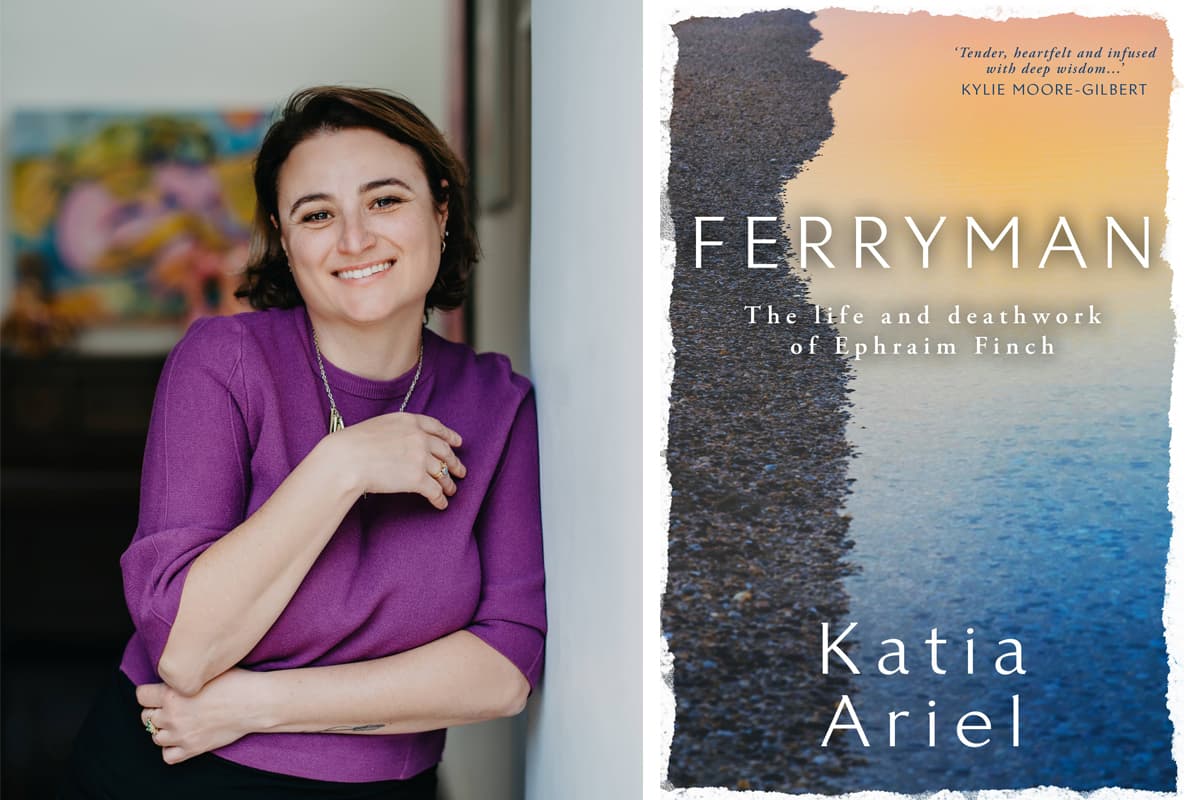
Woman, abstract book cover

Katia Ariel with the cover of her book Ferryman, about Ephraim Finch.

Published: 3 June 2025

Last updated: 5 June 2025

Shortly after the release of her first book, a lyrical memoir that was short-listed for the Stella Prize, Katia Ariel got a call from another publisher.

Catherine Lewis, from Wild Dingo Press, wanted to talk about an idea that had landed on her desk: to tell the story of the man who had been the Director of Melbourne’s Chevra Kadisha for 30 years, Ephraim Finch. She asked if Ariel had heard of him.

“Well, yeah, because I’m a Jew who’s lived almost her entire life in Melbourne. Of course I’d heard of him. He’s so central, he’s so beloved, he’s the hub in a wheel in lots of ways.”

Then came an amazing moment, Ariel says. “We looked at each other and she said, ‘It’s you. You’re the author for this book.’ And I kind of went, ‘Yeah, it is me.’”

The idea of writing about Finch’s life and his extraordinary legacy had been “in the ether” for a long time, says Ariel. A few people had interviewed him and one had done so comprehensively, amassing boxes and boxes of transcripts. Finch himself had extensive detailed journals. All of this material was made available to Ariel.

Was the sizable bulk of all this prior paperwork a burden to Ariel? “No, it was wonderful. Writing a life is such an immense undertaking, any background briefing that came my way I was so eager to receive and incorporate.” She points out that she also had the huge luxury of a living subject she could interview.

In writing about Finch the man, Ariel had to cover a lot of information about Jewish teaching and customs. How much did she know and how much required research?

“I knew more than I realised. The thing about being raised in any sort of cultural tradition, you absorb things. I have never been raised in a religious home. I come from the Soviet Union where my childhood was forcibly atheist, but as soon as we came here, we started to practise things in our own modest, secular way.”
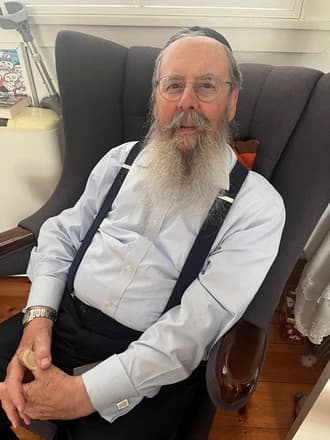
Ephraim Finch
Ephraim Finch

Through her experience of funerals, Ariel, “knew about the way everybody pitches in to cover the casket in soil, the sound of that earth thudding on the wood, all these kinds of sensorial things were familiar to me about the Jewish way of death and burial.” When it came to issues around protocol or what the Torah has to say, “that was readily accessible to me in books that Ephraim gave me, but also I just called up friendly rabbis and they helped me.”

Finch, who is now 80, proved to be both a funny and eloquent raconteur. Ariel describes him as a natural poet who has music to his language. In the two years Ariel spent interviewing and writing about Finch, she became very close to his community. The result is a poignantly drawn portrait of a man who seems to embody the whole notion of the Jewish ritual around death.

A living repository

“Oh, entirely. I think his whole body carries it. I think he’s a living repository of those traditions and those rituals. In the end I saw there was no difference between the man and his vocation because he gave himself over to the work so completely”, says Ariel.

This level of devotion takes on a new significance when you learn that Ephraim Finch grew up as Geoff, a working-class Anglo-Aussie butcher’s son who converted to Judaism with his wife Cas when they already had three children. Many conversions happen when one partner in a couple wants to take on the religion of the other. But neither of the Finches were Jewish; they just shared a longing to join the faith.

When the Chevra appointed Finch to the position of Director - replacing a rabbi who was moving on to minister to his own congregation - they got lucky. As well as his reverence and respect for the people in his care, Finch enlarged the role, creating an archive of stories and details honouring the individuals he buried.

Natural listener

“He is just a natural storyteller and a natural listener. I think he gets his energy from that way of connecting, of sitting and really listening to another human being and the details of their life. Obviously, I wasn’t there in 1986 when he first sat down in that director’s chair, but I just could picture him like a sponge, so thirsty for the humanity that was before him.”

At the time, Melbourne had one of the largest populations of Holocaust survivors outside Israel, so these were many of the lives Finch documented. “I think it felt urgent to him because in 1986 we were much closer to the Shoah than we are now. He was just burning with the desire to document as much as he could and stop the stories from disappearing through the cracks.”

In 2005, when one of his daughters suggested she and her parents visit Auschwitz, Finch’s initial response was, “I don’t want to go back there.”

“But Abba, you’ve never been there,” she replied.

Ariel attributes that unconscious slip of the tongue to the fact that, by this time, Finch had listened to and absorbed thousands of stories about it and internalised those experiences. The trip went ahead, nevertheless, in the freezing winter. As Finch says in the book, “Poland does not deserve to be seen in colour as all the blood’s been taken out of the place. I want to see it in black and white.”

Apart from the numerous Holocaust stories Finch gathered, Ariel says there were so many other lives he remembered. Soldiers returned from war, people who had died from illness, children and babies he buried. “When you bury 10,000 people, when you do this job for 30 years, it’s an impossible volume of stories. I had to stop somewhere.”

Because she can’t relate all of them, Ariel chooses a handful to illustrate Finch’s unstinting service for those in his care. One of those stories is about a family who lost a child to road trauma. She interviewed the father about what it was like to be looked after by Finch at this catastrophic juncture.

He emphasised that Ephraim held him and comforted him, and described him as an “unbelievable person, a real chossed (someone who gives of themselves unconditionally)… I don’t know what it is, but he just has that heart for it.”

Communal webbing

Ariel says this chapter also looks at “communal webbing” and how we support each other in times of crisis. Everyone in the neighbourhood, the school and the shul and the shopkeepers, came together, and the chapter describes about the many ways his community has honoured his son’s memory.

In the early pages of this book. Ariel acknowledges that she is a secular humanist who grapples with some Jewish beliefs and cherry-picks the customs she observes. “That is, until there is a great life event, namely a birth or a death… Never have I been so grateful for the structure, the scaffolding, of ancient tradition, as when a loved one passes… All of it is a firm grip on a measureless dark.”

Ariel says that she has always known the value of ritual and ceremony in marking significant moments in our lives. “I’ve carried that with me for a long time and that’s partly why I put my hand up for this book so readily. I just knew that sitting at the foot of Ephraim I was going to get a kind of master class in how we ritualise our darkest hour.”

Now that the book is about to be launched, Ariel says, “my next thing is just to have a big rest because it really tested my heart”. This is not surprising because, as with her first book, The Swift Dark Tide (2023), a deeply personal memoir, she has written Ferryman candidly and with profound emotion.

“It’s both draining and energising. My whole purpose in writing is to give of myself with extreme depth and generosity. Otherwise, what’s the point? I don’t see value in giving the reader something superficial. There’s quite enough of that in our media already.”

Just as the Melbourne Chevra Kadisha found in Ephraim Finch the right person to be its director, his book found its perfect author in Ariel.

Ferryman: The Life and deathwork of Ephraim Finch by Katia Ariel will be published on June 1. 

MELBOURNE LAUNCH

Ferryman will be launched by Arnold Zable at Glen Eira Town Hall in Caulfield on June 12, from 6.30pm-8pm. The launch is sold out. CLICK HERE to go on the waiting list.

SYDNEY LAUNCH

Katia Ariel will be in conversation with Michaela Kalowski in Sydney at the Double Bay Library Gallery on June 18 at 7pm. CLICK HERE TO BOOK

You might also like
  • Rediscovered in Melbourne: the 75-year odyssey of Nazi-looted Jewish books
    Jason Schulman
  • When the state faltered, civil society and Diaspora Jewry stepped up
    Shahar Burla
  • The case for leaving graffiti up for a while
    Adam Slonim
logomark.67a07ee3
We believe in the free flow of information

Republish our articles for free, online or in print, by using our Creative Commons licence

You might also like

    Commissioner Virginia Bell
    Royal CommissionAnalysisAustralia

    Now is the time for the Royal Commission to deliver, not be politicised

    Dean Sherr 2
    Jewish word map
    FeatureArts & Culture

    Was the barmi a shemozzle? How Australians use Jewish words 

    Caroline Hendy & Emma Breslow 1
    PENNY WONG P
    Israel Hamas WarAnalysisAustralia

    Zomi investigation delivers new low in Australia-Israel relations

    Michael Visontay 7

About the author

Aviva Lowy

Aviva Lowy

Aviva Lowy started her career as a radio journalist with 2JJJ and the ABC. She has written on a broad range of subjects, from food and travel to science and health.

More from the author

FeatureArts & Culture

The boys who lived

ReviewArts & Culture

Books: Noble orphan, a hotel nightmare and Miriam’s wisdom

ReviewArts & Culture

Books: Austrian ghosts, a New Yorker’s joyride, intrigue in Istanbul

ReviewArts & Culture

Books: 100 Israeli lives, German traitors, passion for romance

Comments1

  • Avatar of Fred Morgan

    Fred Morgan4 June at 02:54 am

    Efraim is a mensch and a treasure to the Jewish community. I can’t wait to read this biography.